Artificial Intelligence has moved from being a futuristic concept to an everyday reality. From writing content and testing software to analyzing data and managing products, AI tools are becoming part of our daily workflows. With this rapid adoption, one question continues to dominate conversations across industries:
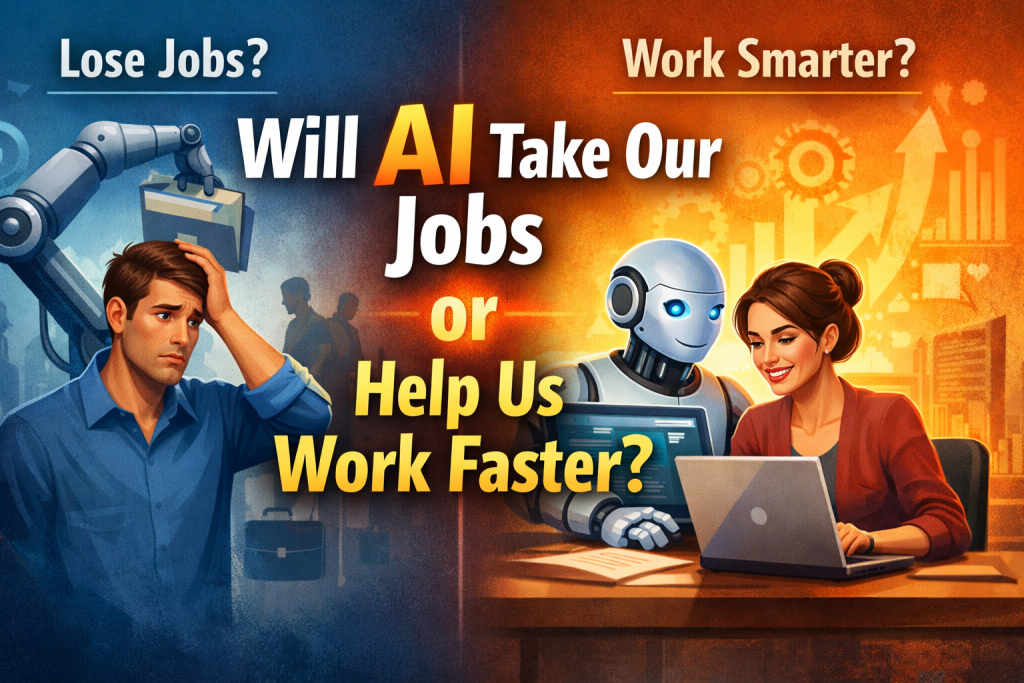
Will AI take our jobs?
It’s a genuine concern—and not an unreasonable one. Every major technological shift in history, from the industrial revolution to automation, has sparked similar fears. But when we look closer, the real story of AI is not about job loss. It’s about how work is evolving.
Here’s a perspective worth considering:
AI won’t take your job. But someone using AI might.
Understanding the Real Impact of AI
AI is not a replacement for human intelligence, creativity, or decision-making. Instead, it acts as a powerful assistant—helping professionals work faster, smarter, and more efficiently. The difference lies not in who AI replaces, but in who adapts.
Let’s break this down with a simple, relatable example.
A Simple Comparison: Two Professionals, One Task
Imagine two content writers assigned to write the same blog article.
Writer A
- Researches and writes everything manually
- Spends around 3 hours crafting the article
Writer B
- Uses AI to generate an initial draft or outline
- Spends 1 hour refining the content, adding insights, and improving quality
- Delivers the same—or even better—result in significantly less time
Both writers possess similar skills. The difference is how they leverage available tools.
Now ask yourself:
- Who is more productive?
- Who can handle more assignments?
- Who brings more value to the organization?
The answer is clear. Productivity wins.
AI Enhances Skills—It Doesn’t Replace Them
One of the biggest misconceptions about AI is that it replaces expertise. In reality, AI amplifies human skills.
- Developers use AI to write cleaner code faster
- Testers use AI to detect patterns and edge cases more efficiently
- Product owners use AI to analyze customer data and market trends
- Writers use AI to overcome creative blocks and focus on storytelling
AI handles repetitive and time-consuming tasks, allowing professionals to focus on what truly matters: thinking, problem-solving, creativity, and decision-making.
The Real Risk Is Standing Still
The biggest risk today isn’t AI itself—it’s choosing not to learn it.
Professionals who ignore AI may find themselves:
- Slower than their peers
- Less efficient in delivering outcomes
- Struggling to meet modern expectations
Meanwhile, those who embrace AI gain a competitive advantage. They work faster, reduce errors, and free up time for higher-value work. Over time, this gap becomes impossible to ignore.
AI and the Future of Work
The future of work is not about humans versus machines. It’s about humans working alongside machines.
Organizations are not looking to replace people—they are looking to:
- Improve speed
- Increase accuracy
- Reduce costs
- Deliver better customer experiences
Employees who understand how to integrate AI into their daily workflows naturally become more valuable. They are seen as adaptable, forward-thinking, and future-ready.
From Fear to Opportunity
Instead of asking, “Will AI replace me?”, a better question is:
“How can AI help me become better at what I already do?”
When viewed this way, AI becomes less of a threat and more of an opportunity—a chance to:
- Upskill yourself
- Stay relevant in a changing job market
- Focus on strategic and creative work
- Grow faster in your career
Final Thoughts
AI is not here to end careers.
It’s here to change how we work.
Those who learn to use AI smartly will move ahead—not because they work harder, but because they work smarter. Those who resist change may find themselves left behind, not by technology, but by people who embraced it.
The choice is simple:
- Fear AI
- Or learn to grow with it
What’s your take?
Do you see AI as a threat—or as a powerful tool for growth?
Comments