How AI is transforming software testing, and why human judgment remains the foundation of quality.
Introduction: When Code Ships Faster, Who Checks It?
Your developers may have shipped twice as much code last quarter using AI coding assistants. Did your testing capacity double, too?
For most QA teams, the answer is no. Traditional automation has reduced repetitive manual testing, but script maintenance, failure analysis, growing regression suites, and release pressure remain persistent challenges. Meanwhile, the pace of change continues to accelerate.
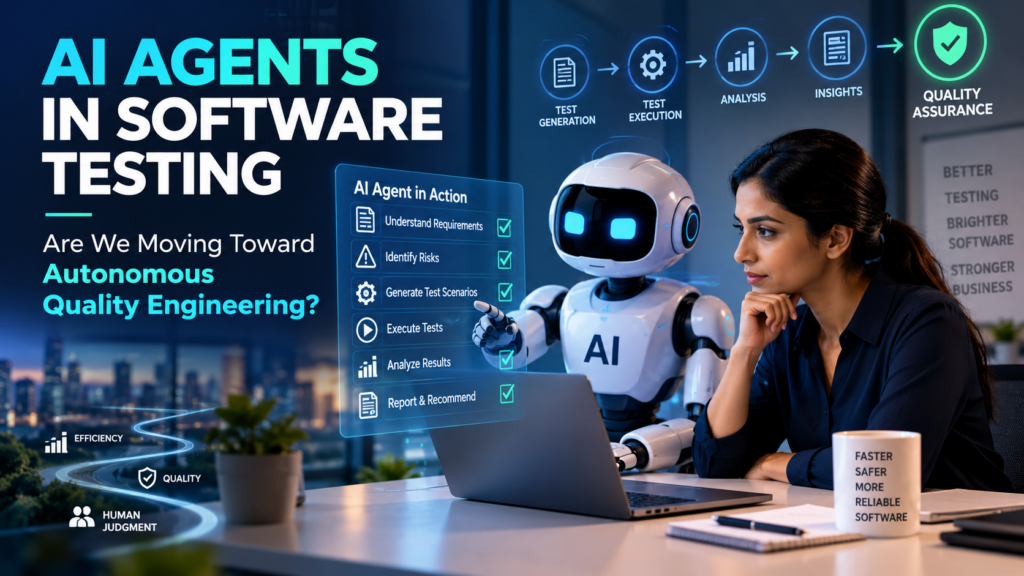
AI agents in software testing promise a different approach. Unlike traditional automation, which follows predefined scripts, an AI agent works toward a goal: it interprets context, selects actions, executes workflows, analyzes results, and recommends next steps.
So, are we moving toward autonomous Quality Engineering?
My answer is yes—but toward bounded autonomy, not full autonomy. AI will increasingly handle repetitive testing activities, while humans remain accountable for defining what “correct” means and deciding whether a release is safe.
This article explores where that boundary lies today, the risks of crossing it too early, and how QA leaders can move toward it deliberately.
1. From Traditional Automation to AI-Driven Testing
Frameworks built with Selenium, Playwright, Cypress, and API testing libraries have made repeatable testing faster and more consistent. However, conventional automation has well-known limitations:
- Script maintenance: UI changes, modified selectors, and evolving workflows can break existing tests.
- Limited adaptability: Scripts follow predefined steps and require updates when application behavior changes.
- Failure analysis: Engineers spend hours reviewing logs, API responses, screenshots, and execution traces.
- Growing regression suites: As applications expand, deciding which tests to execute within a limited time becomes increasingly difficult.
- Skill dependency: Building and maintaining reliable frameworks requires substantial technical expertise.
AI can support this lifecycle at two levels, and the distinction matters.
AI-assisted testing helps engineers perform individual tasks, such as drafting test scenarios from requirements, suggesting automation code, summarizing failures, and identifying coverage gaps.
Agentic testing coordinates a sequence of tasks toward a goal, such as generating tests, executing them, analyzing results, and reporting findings—with the agent selecting subsequent actions based on the results.
Neither approach guarantees correctness. The outcome still depends on the requirements, test oracles, data, environment, and controls surrounding the system.
2. What AI Agents Can Do: A Digital Payment Journey
Consider a new feature in an online money transfer application. A customer enters transfer details, selects a recipient, receives a fee quotation, confirms the transaction, and expects a transaction reference.
Here is how a suitably configured AI agent could support this workflow—and where a QA engineer remains involved.
Step 1: Understand the requirements
The agent extracts business rules, acceptance criteria, transaction limits, and error conditions.
Step 2: Identify risks
It prioritizes risks such as incorrect fee calculations, duplicate transfers, invalid recipient details, and transaction-state inconsistencies.
Step 3: Generate test scenarios
The agent proposes positive, negative, boundary, and exception scenarios, including:
- Transfers with valid sender and recipient details.
- Transactions exceeding the permitted transfer limit.
- Unsupported source or destination currencies.
- FX rates expiring between quotation and confirmation.
- Fee-rounding issues at currency boundaries.
- Duplicate submissions or retries after a timeout.
- Concurrent transfers from the same account.
- Authentication failures during transaction confirmation.
The QA engineer must confirm that these scenarios reflect the actual business rules and cover the relevant risks.
Step 4: Execute tests
When connected to an approved browser or test environment, the agent executes selected journeys and collects evidence. This can be particularly useful for exploratory paths and applications with frequently changing UI elements.
Step 5: Validate outcomes
The actual results are compared against independently defined expectations for transaction status, amount, fees, and reference details.
A successful sequence of clicks is not proof of correct behavior.
Step 6: Analyze failures
Suppose 25 out of 200 regression tests fail. Instead of investigating every failure from scratch, the agent correlates logs, screenshots, API responses, and execution history to group failures into categories such as:
- Application defects.
- Environment or connectivity issues.
- Test-data problems.
- Configuration failures.
- Automation-script defects.
Engineers then validate the likely root causes and prioritize investigation based on impact and evidence.
Step 7: Report findings and support maintenance
The agent summarizes failures, coverage gaps, and remaining risks. It may also suggest locator updates or identify redundant tests for review.
One important warning: if an agent changes an assertion simply to make a test pass, it can conceal a genuine defect.
The goal is not to maximize the number of passing tests; it is to maximize confidence that tests verify the correct behavior.
For financial applications, additional safeguards are essential, including isolated test data, restricted permissions, idempotency checks, audit trails, and strict controls against unintended production transactions.
3. Five Levels of Autonomy in Testing
Autonomy is not an all-or-nothing decision. Borrowing the concept of autonomy levels from self-driving cars, we can use a similar model to understand the evolution of AI-driven testing.
| Level | What AI does | What humans do |
|---|---|---|
| Level 0 — Manual/Scripted | No autonomous decision-making | Design, write, execute, and analyze tests |
| Level 1 — Assisted | Suggests test cases, code, and failure summaries | Write, review, and approve tests |
| Level 2 — Partial | Generates and executes tests; triages failures | Review outputs and own the test oracles |
| Level 3 — Conditional | Executes end-to-end workflows within defined guardrails | Approve exceptions and changes to assertions |
| Level 4 — High | Selects what to test, when to test, and how deeply to test within its authorized scope | Audit the system and retain accountability for release decisions |
In my experience, many teams operate primarily at Level 1, with pockets of Level 2 in test generation and failure triage. Level 3 is achievable today for well-understood, low-risk workflows with strong guardrails.
Level 4 requires greater caution. The decision is not based on tool maturity alone; it also depends on whether the requirements, test oracles, and controls are reliable enough to support the required level of autonomy.
The appropriate level also varies by application area. A marketing page and a payment confirmation workflow should not be subject to the same autonomy policy.
The most effective organizations will not necessarily be those with the highest level of autonomy. They will be those that understand where autonomy is safe, how results are verified, and when human intervention is necessary.
4. The Hidden Risks of Autonomous Testing
| Risk | What can go wrong | What QA should do |
|---|---|---|
| Incorrect test cases | AI misinterprets ambiguous requirements or misses business conditions. | Validate scenarios against acceptance criteria, business rules, and a risk-based coverage model. |
| False-positive results | The agent accepts an unexpected outcome or bypasses a failed check. | Maintain independent assertions, preserve evidence, and review changes to expected behavior. |
| Correlated AI errors | AI generates both application code and tests, allowing the same misunderstanding to affect both. | Derive test oracles independently of the implementation and retain human-authored checks for critical paths. |
| Unreliable execution | The agent follows different paths across runs as context, state, or model behavior changes. | Use controlled environments, repeatability checks, and deterministic validations wherever possible. |
| Prompt injection | Malicious instructions embedded in pages, logs, or tickets influence the agent’s actions. | Treat application content as untrusted input and restrict tool access and permissions. |
| Security and data privacy | Agents access sensitive data or systems beyond their intended scope. | Apply least-privilege access, approved data policies, audit logging, and limits on high-impact actions. |
| Cost and latency | Model calls on every CI run increase costs and slow pipelines. | Set per-run budgets, reuse suitable results where safe, and reserve agents for high-value stages. |
| Overdependence on AI | Teams accept AI-generated scripts and reports without understanding them. | Ensure engineers can review the logic, challenge findings, and explain the supporting evidence. |
Adopting AI testing without appropriate controls can create a false sense of security. These are the risks QA leaders should plan for.
The principle behind every row is simple: AI should make Quality Assurance more effective, not less accountable.
5. How QA Managers Can Start Adopting AI
The challenge is not simply choosing a tool. It is identifying where AI can deliver measurable value while protecting product quality.
A phased approach is more practical than attempting full autonomy from day one.
Phase 1: Measure the baseline
Before starting a pilot, record current test-design effort, automation maintenance effort, escaped defects, and regression execution time.
Without a baseline, claims of improvement are difficult to validate.
Phase 2: Start with repetitive, low-risk activities
Choose tasks that consume engineering time but have clearly verifiable outcomes, such as:
- Drafting test cases from well-defined requirements.
- Generating API test-data variations.
- Summarizing automation failures and grouping recurring defects.
- Identifying potential gaps in regression coverage.
Phase 3: Run a controlled pilot
Choose one application, service, or API workflow with a stable test environment.
Compare AI-assisted testing with the existing approach using the same requirements and quality expectations. Track effort, accuracy, maintainability, and defect detection rather than relying on tool demonstrations or vendor claims.
Phase 4: Introduce agentic workflows with governance
Connect proven capabilities into a controlled workflow covering test generation, execution, analysis, and reporting.
Clearly define what the agent can do independently, what requires approval, and what actions are prohibited.
Establish rules for:
- Test review and approval.
- Access to source code and test data.
- Handling sensitive information.
- Changes to assertions and automation scripts.
- Evidence retention and auditability.
- Human approval of release-critical decisions.
Phase 5: Measure business outcomes
Evaluate AI adoption based on measurable results, not the number of generated test cases.
Useful metrics include:
- Test-design, automation-development, and maintenance effort.
- Defect-detection effectiveness and escaped defects.
- False-positive and false-negative rates.
- Regression execution time and result reliability.
- Cost per validated release.
The objective is to demonstrate that AI improves testing quality and efficiency—not merely that it produces more output.
6. How Will the QA Engineer’s Role Change?
Will AI replace testers?
My view is that the role will change significantly rather than disappear. As AI takes on more repetitive work, QA engineers will increasingly focus on understanding business behavior, identifying hidden risks, evaluating AI-generated outputs, and designing quality strategies.
This evolution requires five key skill areas.
- Technical expertise: API testing, automation architecture, CI/CD, observability, and AI-assisted engineering.
- Analytical thinking: Risk identification, root cause analysis, edge-case discovery, and evidence-based decision-making.
- Business understanding: Customer journeys, business rules, regulatory requirements, and the impact of defects.
- AI literacy: Understanding model limitations, validating generated outputs, and designing appropriate guardrails.
- Quality ownership: Building quality into the development lifecycle rather than treating testing as a final checkpoint.
For QA managers, this means investing in continuous learning, encouraging experimentation, and building confidence in AI without allowing it to replace critical thinking.
The goal should be to develop stronger Quality Engineers—not simply smaller QA teams.
Conclusion: AI Can Accelerate Testing, but Quality Requires Judgment
AI agents represent an important evolution in software testing. They can help teams generate scenarios faster, execute workflows, investigate failures, and make better use of testing resources.
However, speed does not automatically translate into quality.
A large test suite can still miss critical defects. A self-healing script can still hide a regression. An AI-generated report can still reach the wrong conclusion.
Yes, we are moving toward autonomous Quality Engineering, one bounded level at a time.
Our responsibility as QA leaders is to decide how much autonomy each part of the testing process should have, verify the outputs, and retain human accountability where the stakes are highest.
The question for every QA leader is no longer simply, “How much can we automate?”
It is:
“How can we use AI to make every release faster, safer, and more reliable—without compromising quality?”
Comments